
A 10-Minute Closing Routine for Your Shop (Cash, Stock, and Udhaar)
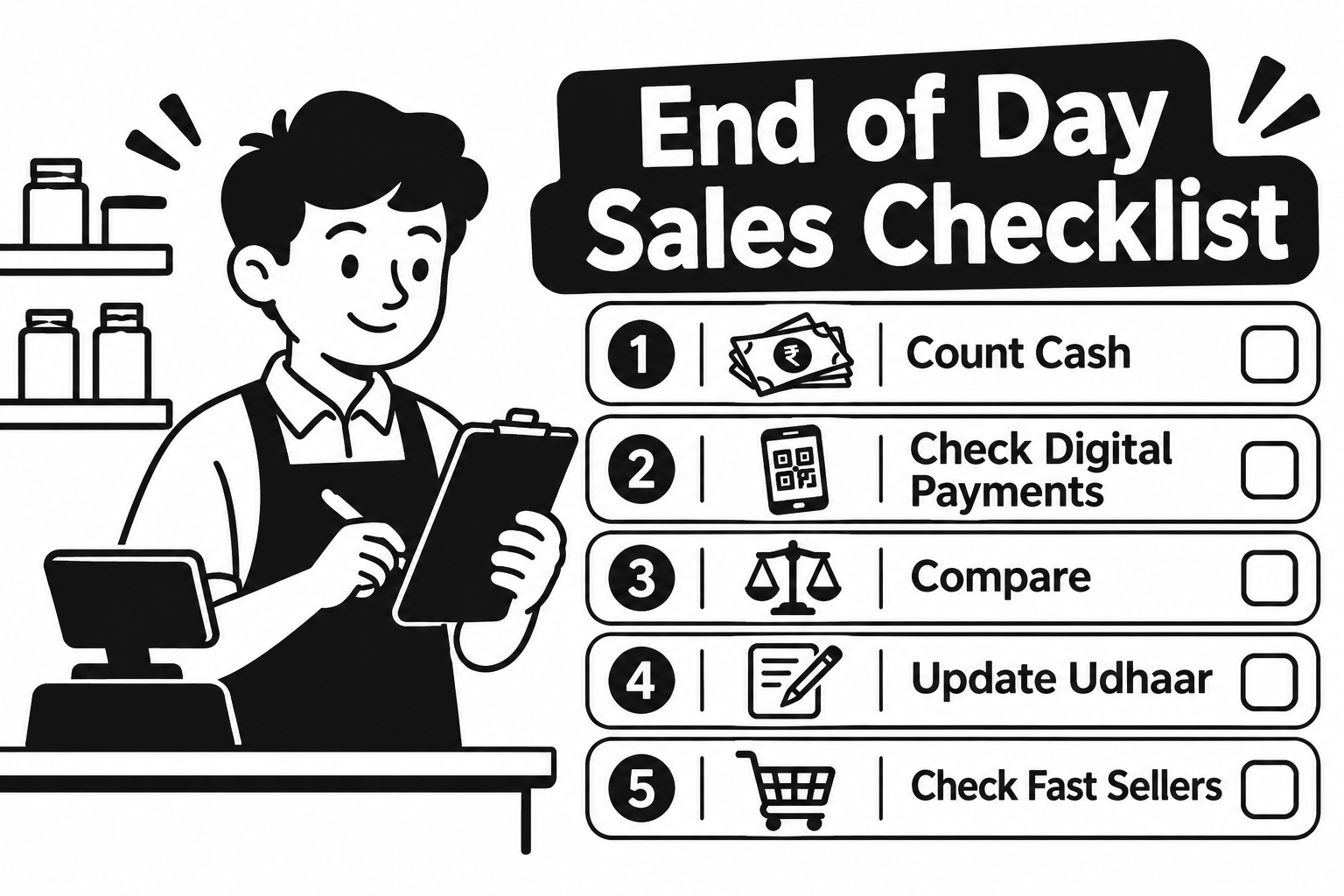
Most shop owners know their sales feel good or bad. Fewer know, at the end of each day, exactly how much money should be in the drawer, how much came through eSewa, Khalti, or Fonepay, and how much customers still owe.
The gap between “I think it was a good day” and “I know what happened today” is where small leaks hide: a wrong change, an unwritten udhaar, a sale nobody recorded, a product that quietly ran out. A short routine at closing time catches these while they are still small and easy to trace.
This routine takes about 10 minutes. You can do it in a notebook, and it works just as well in a spreadsheet.
What you need
- A notebook or a simple sheet with one row per day
- Your udhaar book (or a list of who owes what)
- A pen and a calculator
- Your phone, to check digital payment totals
The 10-minute routine
1. Count the cash (2 minutes)
Count everything in the drawer, then subtract the cash you started the day with. Write the result as cash counted. Do it the same way every day, and keep a fixed amount to start tomorrow with, so the numbers are easy to compare.
2. Check digital payments (2 minutes)
Open your payment apps and write down the day’s total for each one: eSewa, Khalti, Fonepay, or whichever you accept. Do not rely on memory or on a customer’s screenshot. The app’s own history is your record.
3. Compare with your sales (2 minutes)
Add your total sales for the day from your bill book, your register, or whatever record you keep. Then compare:
Sales recorded = cash counted + digital payments + udhaar given today
The two sides will not always match. That difference is the most useful number you will write down all day.
4. Update udhaar (2 minutes)
Write two things: new udhaar given today, and udhaar collected today. Then write the total each person owes right now. If a customer took goods on credit and nobody wrote it down, today is the day you find out, not at the end of the month.
5. Check your fast sellers (2 minutes)
Look at your five or ten fastest-moving items. Are any nearly gone? Write them on tomorrow’s buying list now, instead of finding out when a customer asks for them. If you have items that have not sold in months, note them too. You will deal with those on a weekly check.
The row to write every day
Keep the same columns every day so you can compare:
- Date
- Cash counted
- Digital payments total
- Udhaar given
- Udhaar collected
- Total sales recorded
- Difference (what does not add up)
- Items to reorder
- Notes (anything unusual)
After a few weeks, this page becomes your most honest record of how the shop actually works.
What to do when the numbers do not match
A small difference on any given day is normal. Change given in the rush, a missed entry, or a rounding habit can all cause it. What matters is the pattern.
- Write the difference down every day, even if it is small. Do not skip the days it feels embarrassing.
- Look for repeats. The same day of the week, the same time of day, the same product, or the same person at the counter.
- Check the simple causes first: an unwritten udhaar, a sale not entered, an expense paid from the drawer without a note.
- Do not accuse anyone from one bad day. A pattern across a few weeks tells you where to look. A single number does not.
Add a weekly check (15 minutes)
Once a week, add three things to the routine:
- Slow stock: list products that have not sold for a long time. Money sitting on a shelf is money you cannot use.
- Udhaar older than you are comfortable with: pick one or two overdue customers and follow up this week.
- Weekly totals: add up the daily rows. Are sales, digital payments, and udhaar moving in the direction you expected?
Common mistakes
- Doing it only when something feels wrong. The routine works because it is boring and daily.
- Mixing personal money with shop money. Take a fixed amount for yourself and write it down. Pulling cash from the drawer without a note is the most common reason numbers never add up.
- Keeping it too complicated. If the routine takes 30 minutes, you will stop doing it. Start with the five steps above and add detail later.
- Counting only cash. Digital payments are part of your sales and need the same daily check.
Start tonight
You do not need new software or a new notebook. Tonight, count the drawer, check your payment apps, and write one line. By the end of the week you will know your shop better than you did on Sunday.
What is your closing routine today? Tell us what works in your shop, and we will share the best ideas in a future guide.